Cybersecurity in the age of software supply chains: lessons from a global vulnerability event
A technical reflection on large scale web vulnerabilities, dependency risk, and what real engineering discipline looks like when modern infrastructure is tested.
Ahmed HassanFeb 18, 2026

Security in Modern Software Is an Architectural Decision
Understanding the New Shape of Cybersecurity
Cybersecurity has changed fundamentally over the past decade. It is no longer confined to firewalls, perimeter protection, or isolated security teams. In modern software ecosystems, security lives inside architecture decisions, dependency management, CI/CD pipelines, and infrastructure design.
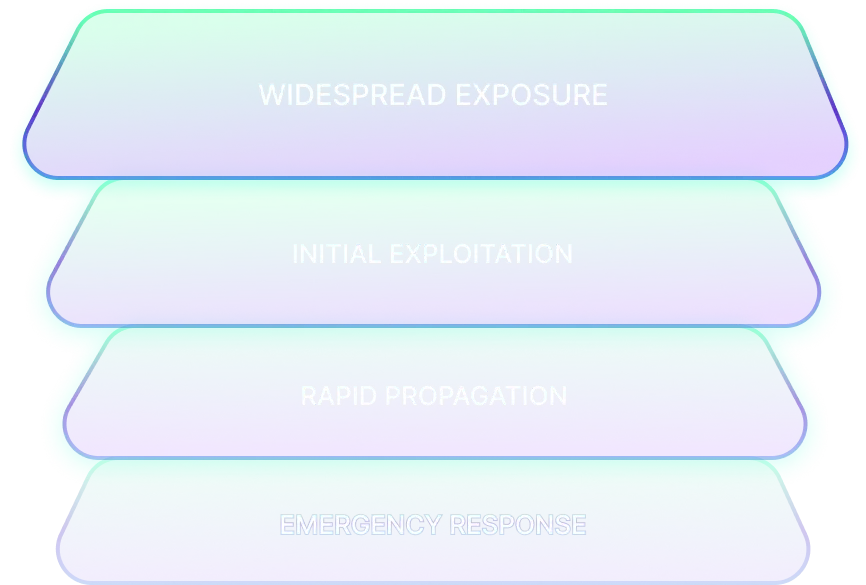
Recent large scale vulnerabilities affecting modern JavaScript ecosystems demonstrated how deeply interconnected today’s applications are. A flaw introduced within a widely adopted open source dependency was able to expose thousands of applications across multiple cloud providers. The vulnerability enabled Remote Code Execution, allowing attackers to execute arbitrary code on affected servers without authentication.
This was not a failure of a single company. It was a reflection of how software is now built: layered, modular, and heavily dependent on open source supply chains.
When a dependency embedded deep inside frameworks such as React or Next.js becomes vulnerable, the blast radius is immediate and global. Cloud platforms, hosting providers, and engineering teams are forced into coordinated response modes almost instantly.
What this revealed is simple: cybersecurity is no longer about defending edges. It is about understanding the full lifecycle of the software you ship.
The Supply Chain Reality in Modern Development
Modern applications are rarely written from scratch. They are assembled from components. A typical production application may depend on hundreds or even thousands of transitive packages.
Each of those packages:
- Has maintainers
- Has release cycles
- Has potential vulnerabilities
- Has implicit trust relationships
Software supply chain attacks exploit this trust. Instead of targeting a company directly, attackers target a dependency that thousands of companies rely on. Once that dependency is compromised or vulnerable, exploitation becomes scalable.
The concept of software supply chain risk is not theoretical. It has been extensively documented by organizations such as the Open Web Application Security Project (OWASP) and the Cybersecurity and Infrastructure Security Agency (CISA). The increasing frequency of these incidents confirms that dependency governance is now a core engineering responsibility, not an optional process layer.
The vulnerability that recently impacted React Server Components is an example of how deeply embedded these risks can be. Because the affected packages were integrated into widely used frameworks, exposure propagated quickly across environments running specific versions.
In such situations, patch velocity becomes more important than public messaging.
Lessons from Inside the Engineering Process
From my experience working across IT setups and project environments, I have observed that security maturity correlates strongly with engineering discipline.
During the recent incident, our internal process moved immediately into verification mode:
- Version audits across active deployments
- Dependency tree inspection
- Environment isolation validation
- Log analysis for anomalous requests
- Patch review and upgrade planning
What allowed this response to remain controlled was not improvisation. It was preparation.
Security resilience is rarely visible when everything is stable. It becomes visible only when the system is under stress. Organizations that treat dependency management as an afterthought struggle during such events. Those that embed governance into their workflows respond methodically.
In practical terms, this means maintaining strict visibility into:
- What versions are deployed in production
- Which services depend on which packages
- How quickly builds can be redeployed
- Whether staging environments accurately mirror production
Without that visibility, response time expands. And in cybersecurity, time equals exposure.
Security Governance Is a Continuous Process
-1.webp)
The Role of Culture in Security Outcomes
Cybersecurity is often framed as a technical issue. In practice, it is deeply cultural.
Over the years, I have worked across HR, recruitment, and project management within technical environments. One pattern consistently appears: the way teams are hired and managed directly affects security posture.
Teams optimized purely for delivery speed often accumulate silent risk. Documentation is skipped. Dependency upgrades are rushed. Review cycles are shortened. Over time, technical debt becomes security debt.
In contrast, teams that value review processes, version control discipline, and documentation tend to detect and mitigate vulnerabilities faster. The difference is not intelligence. It is structure.
Leadership decisions influence whether security is seen as friction or as responsibility. When leadership treats patching cycles, monitoring, and testing as core engineering functions rather than optional overhead, the organization becomes resilient by design.
Security failures are rarely caused by ignorance. More often, they result from prioritization decisions made long before an incident occurs.
Engineering Execution During Vulnerability Events
When a large scale vulnerability surfaces, engineering teams must move through clear phases: assessment, containment, remediation, and review.
Assessment begins with version validation. It is impossible to patch effectively if you do not know what is running in production. Dependency inventory systems and build artifact tracking become critical here.
Containment requires isolating affected services and limiting exposure. This may involve temporary firewall rules, traffic filtering, or disabling vulnerable functionality until patches are applied.
Remediation focuses on upgrading to fixed versions and validating compatibility across environments. In frameworks with tightly coupled dependencies, this step requires careful regression testing to avoid cascading failures.
Finally, review ensures that lessons are documented. Post incident reviews are not administrative exercises. They are architectural recalibrations. They identify weaknesses in monitoring, deployment processes, or dependency governance.
The organizations that emerge stronger from such events are those that treat incidents as engineering inputs, not public relations challenges.
Key Phases of Vulnerability Response
Assessment
Version Audit & Inventory
Containment
Isolate & Protect Systems
Remediation
Upgrade & Validate Fixes
Review
Analyze & Learn Lessons
Assessment
Version Audit & Inventory
Containment
Isolate & Protect Systems
Remediation
Upgrade & Validate Fixes
Review
Analyze & Learn Lessons
Cybersecurity as an Architectural Principle
There is a common misconception that moving to reputable cloud providers inherently reduces security risk. While cloud platforms provide infrastructure security controls, application level vulnerabilities remain the responsibility of development teams.
Framework popularity does not guarantee security. Modern frameworks evolve rapidly, and rapid evolution increases complexity. Complexity, when unmanaged, increases attack surface.
Security must therefore be designed into:
- Infrastructure configuration
- CI/CD pipelines
- Dependency review processes
- Access control systems
- Logging and monitoring frameworks
This is not about over engineering. It is about acknowledging that software systems today operate in adversarial environments.
Architectural decisions determine blast radius. Environment segmentation, least privilege access models, and secret management practices can dramatically reduce the impact of remote code execution vulnerabilities.
In that sense, cybersecurity is not separate from software engineering, it is software engineering.
Looking Ahead: The Next Phase of Threat Evolution
Cybersecurity threats are becoming more automated and more scalable. AI assisted vulnerability discovery, automated exploit kits, and large scale scanning tools reduce the cost of attack while increasing reach.
As applications become more distributed and reliant on microservices, APIs, and serverless architectures, the number of integration points increases. Each integration point is a potential vulnerability surface.
Future ready organizations will not rely solely on reactive patching. They will invest in:
- Continuous vulnerability scanning
- Dependency lifecycle governance
- Secure coding standards
- Infrastructure-as-Code validation
- Regular security audits
Security will increasingly define brand trust. Clients and partners expect resilience, not just functionality.
Conclusion
The recent global vulnerability event served as a reminder that modern software is deeply interconnected and inherently exposed to supply chain risks.
Cybersecurity is not a feature that can be added later. It is a structural property of well engineered systems. It reflects the maturity of workflows, the discipline of deployment practices, and the clarity of leadership decisions.
From my experience across technical environments, one lesson remains consistent: the strength of a system mirrors the strength of the processes that built it.
Organizations that embed security into architecture, culture, and execution will navigate future incidents with control. Those that treat it as secondary will continue to react under pressure. The difference is in the discipline, not the tools.