Composable architecture: the core infrastructure trend behind emerging technologies
How modular system design is redefining cloud platforms, AI pipelines, distributed systems, and modern software engineering at scale.
Ahmed HassanMar 19, 2026
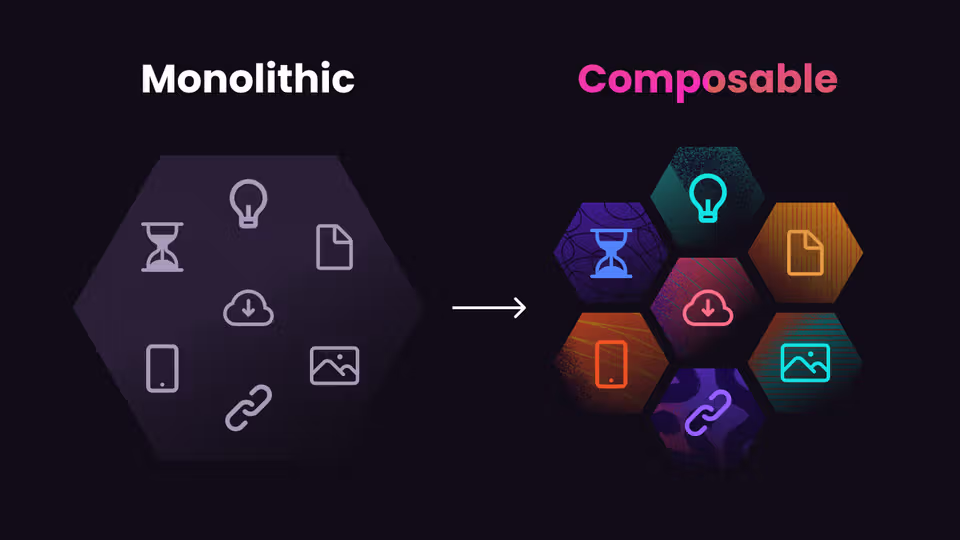
Modern Software Systems Are No Longer Built as Units but Assembled as Ecosystems
The Architectural Shift Defining Emerging Technology
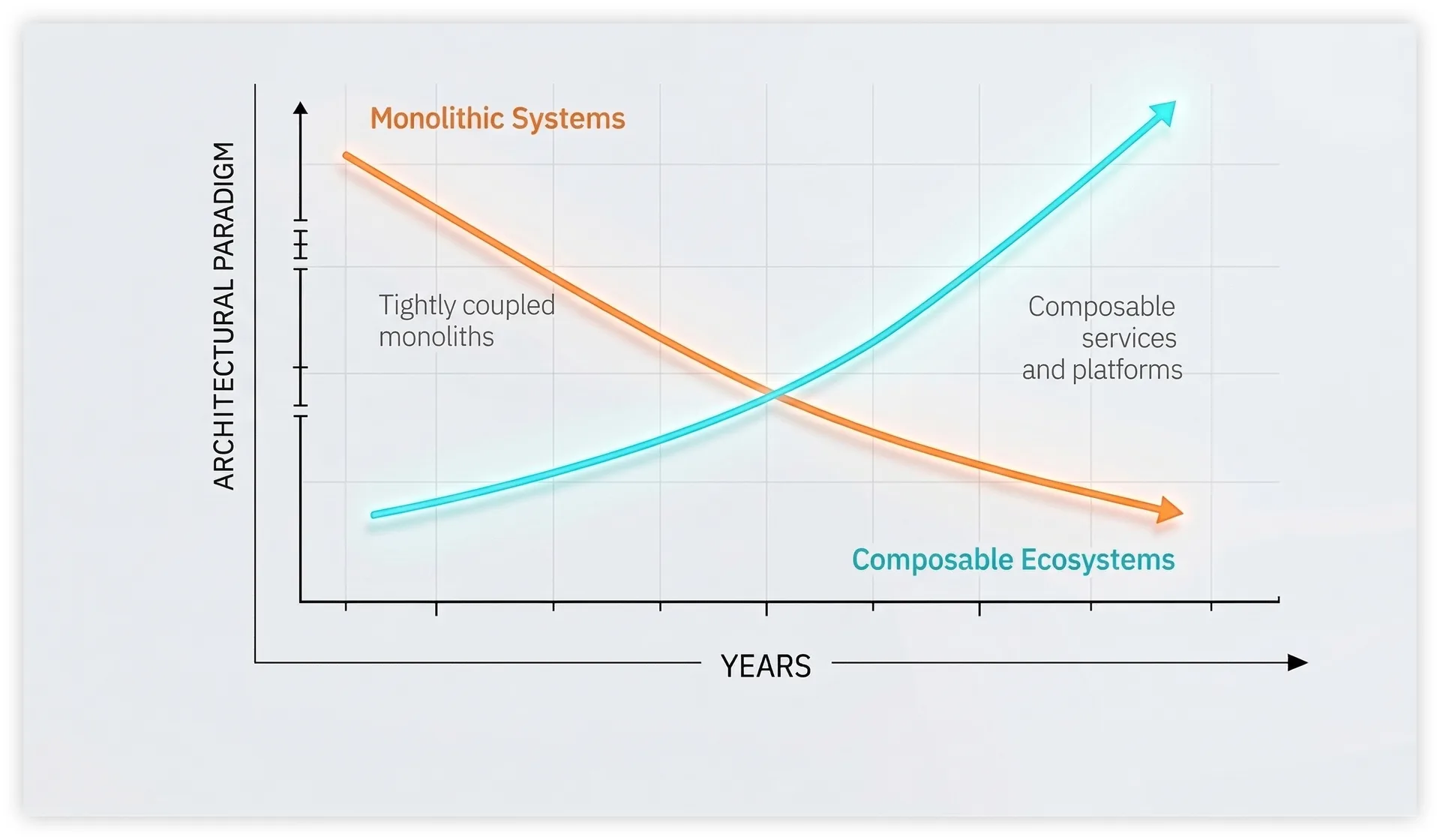
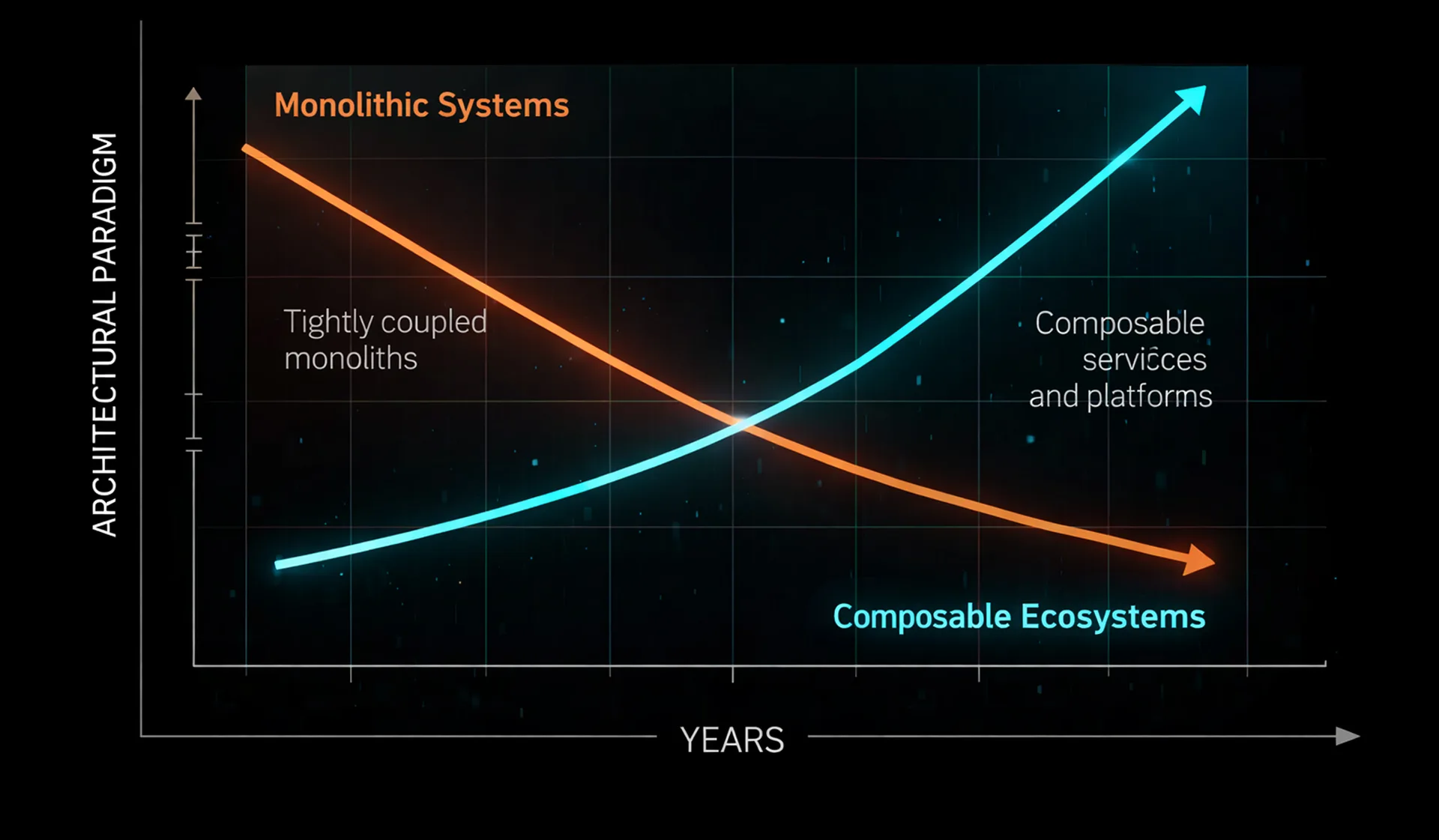
Emerging technologies often capture attention through algorithms, frameworks, or product innovations. However, the true driver behind modern technological acceleration is architectural transformation. Across industries, software systems are moving away from tightly coupled monoliths toward composable, modular infrastructures designed for scalability, adaptability, and operational resilience.
Composable architecture is not a design pattern limited to one sector. It is becoming a cross domain infrastructure principle. Cloud platforms separate compute from storage. AI systems decouple model training from inference pipelines. Distributed systems isolate control planes from data planes. Frontend applications operate independently from backend services through API contracts. Each of these examples reflects a fundamental architectural shift toward modularity.
This shift is enabling emerging technologies to scale without inheriting the constraints of earlier system designs.
From Monolithic Systems to Modular Ecosystems
Traditional monolithic architectures centralized business logic, data access, and presentation layers within tightly integrated deployments. While this model simplified early development, it introduced significant limitations at scale, including deployment rigidity, limited fault isolation, and constrained horizontal scalability.
Modern systems prioritize separation of concerns across functional boundaries.
Key transitions include:
- Decomposition of monoliths into microservices or modular monoliths
- Isolation of compute workloads from persistent storage
- API first service exposure
- Independent deployment pipelines
- Domain driven service segmentation
The architectural outcome is not simply distributed deployment. It is an ecosystem of interoperable components that can evolve independently without destabilizing the broader system.
Separation of Compute and Storage in Cloud Native Systems
One of the most significant infrastructure shifts has been the decoupling of compute and storage layers in cloud environments.
In traditional on premises architectures, storage and compute were vertically integrated within fixed hardware environments. Modern cloud native platforms separate these layers, allowing dynamic allocation of compute resources while data remains persistently managed across distributed storage systems.
This architectural separation enables:
- Elastic scaling of stateless compute services
- Independent lifecycle management of storage systems
- Cost optimization through workload aware provisioning
- Improved fault tolerance through redundancy
Technologies such as container orchestration platforms, serverless runtimes, and distributed object storage systems are built around this principle. The result is an infrastructure model where performance and persistence are optimized independently.
Rise of Composable Architecture
Composable AI Pipelines and Distributed Intelligence
Artificial intelligence systems further illustrate the importance of modular architecture.
Modern AI infrastructure separates:
- Data ingestion pipelines
- Feature engineering layers
- Model training environments
- Model registry systems
- Inference services
- Monitoring and feedback loops
Training clusters operate in high performance compute environments, while inference services scale horizontally across edge or cloud environments depending on latency requirements. Model registries maintain versioned artifacts independent of runtime execution contexts.
This composability allows organizations to iterate on models without redeploying entire systems. It also enables hybrid deployment strategies where inference runs near end users while centralized systems manage orchestration and governance.
As AI workloads increase in scale and complexity, modular pipeline design becomes essential for observability, reproducibility, and performance optimization.
Control Plane and Data Plane Isolation in Distributed Systems
Another defining characteristic of modern infrastructure is the separation of control plane and data plane operations.
The control plane governs configuration, orchestration, and policy enforcement. The data plane handles runtime execution and real time traffic. Isolating these layers enhances scalability and reliability by preventing configuration management processes from interfering with operational workloads.
Service mesh architectures, distributed networking frameworks, and container orchestration systems are built around this separation. Observability platforms integrate across both planes, providing unified telemetry without tightly coupling operational logic.
This architectural discipline reduces systemic risk and improves upgrade strategies in high availability environments.
API First Ecosystems and Interoperable Service Contracts
Composable systems rely on clearly defined service boundaries. API first development ensures that services communicate through stable contracts rather than internal dependencies.
Well designed API contracts enable:
- Independent service evolution
- Polyglot technology stacks
- Third party integration
- Automated testing and validation
- Scalable partner ecosystems
As organizations expand into multi cloud and hybrid deployments, API governance becomes critical infrastructure. Versioning strategies, authentication frameworks, and schema validation pipelines are no longer secondary considerations but core architectural components.
Composable architecture depends on predictable service interoperability.
Infrastructure as Code and Platform Engineering
The emergence of Infrastructure as Code has operationalized composability at the infrastructure layer.
Declarative provisioning systems enable repeatable deployment of compute clusters, networking policies, storage configurations, and security controls. Platform engineering teams abstract these capabilities into internal developer platforms that standardize environment creation and deployment workflows.
This approach reduces cognitive load for development teams while maintaining architectural consistency across distributed systems.
Composable infrastructure is therefore not only about application design. It extends to deployment pipelines, security enforcement, monitoring systems, and compliance controls.
Composable Infrastructure Stack
Applications
Web • Mobile • AI
APIs & Services
Microservices • APIs
Platform Layer
Containers • Kubernetes
Infrastructure
Compute • Storage • Network
Applications
Web • Mobile • AI
APIs & Services
Microservices • APIs
Platform Layer
Containers • Kubernetes
Infrastructure
Compute • Storage • Network
Edge Computing and Distributed Workload Orchestration
Emerging technologies such as edge computing further reinforce modular design principles.
Latency sensitive workloads require inference and processing capabilities near end users. At the same time, centralized systems handle analytics aggregation, policy enforcement, and long term storage.
This distributed topology is only viable through modular workload orchestration. Services must operate independently across heterogeneous environments while maintaining consistency through orchestration layers.
Composable architectures allow workloads to be relocated, replicated, or scaled dynamically without redesigning system foundations.
The Strategic Implications of Composable Architecture
Composable architecture is not a trend driven by tooling. It is a response to systemic complexity in modern technology ecosystems.
As organizations integrate cloud native systems, AI infrastructure, real time analytics, distributed databases, and cross platform services, tightly coupled architectures become unsustainable.
The strategic benefits of composable systems include:
- Accelerated innovation through independent service iteration
- Improved resilience through fault isolation
- Scalable performance through workload specific optimization
- Flexible deployment across cloud, hybrid, and edge environments
- Reduced long term technical debt through clear service boundaries
This architectural paradigm provides the structural foundation upon which emerging technologies operate.
Conclusion
Emerging technology trends such as artificial intelligence, edge computing, real time analytics, and distributed platforms are often framed as breakthroughs in algorithms or frameworks. In reality, their scalability and reliability depend on a deeper architectural transformation.
Composable architecture has become the core infrastructure principle enabling these systems to evolve independently while operating cohesively. By separating compute from storage, isolating control planes from data planes, enforcing API driven interoperability, and modularizing AI pipelines, modern software systems achieve both adaptability and stability.
For engineering organizations, the focus is no longer simply adopting new technologies. The priority is designing systems that can integrate future technologies without architectural rework.
Composable infrastructure is not an optional optimization. It is the foundation for sustainable, scalable, and future ready software ecosystems.