Digital Transformation is architectural transformation
Why meaningful digital transformation requires systemic redesign of infrastructure, data platforms, and software architecture rather than incremental tool adoption.
Ahmed HassanMar 19, 2026

Transformation Begins at the Architecture Layer Not the Application Layer
Reframing Digital Transformation
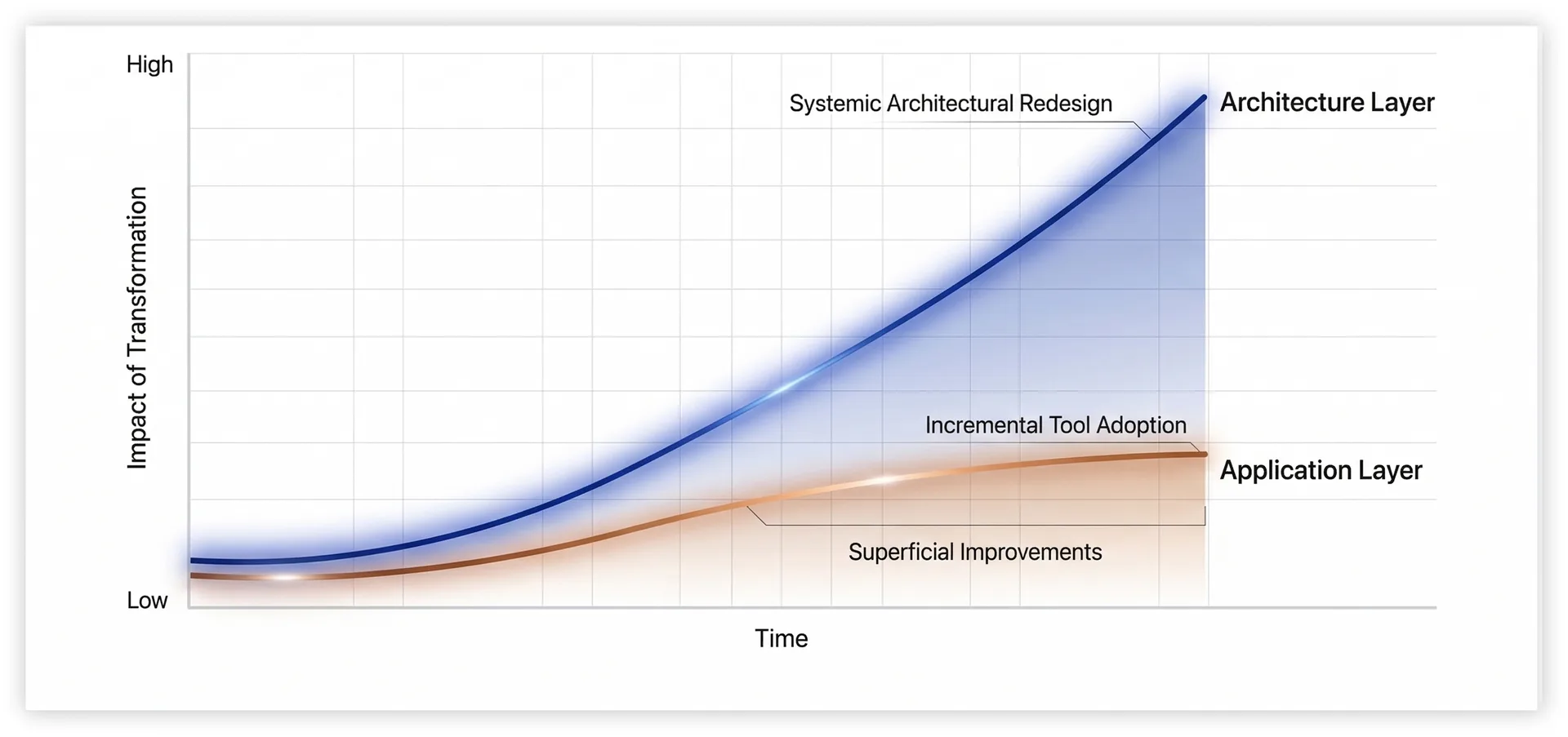
Digital transformation is often described as the adoption of cloud platforms, automation tools, or modern applications. In practice, these initiatives frequently underdeliver because they operate at the surface layer of the technology stack. Replacing user interfaces or migrating isolated workloads does not fundamentally change how systems behave, scale, or evolve.
True digital transformation occurs when the underlying architecture is redesigned.
Architecture determines how data flows, how services communicate, how systems scale, how failures are isolated, and how security policies are enforced. Without architectural modernization, organizations merely digitize legacy inefficiencies.
At its core, digital transformation is a structural engineering effort.
The Legacy Constraint Problem
Most enterprises operate on legacy systems characterized by:
- Tightly coupled monolithic applications
- Shared databases across multiple services
- Manual deployment processes
- Static infrastructure provisioning
- Limited observability
- Siloed data environments
These constraints inhibit scalability, slow development cycles, and increase operational risk. Attempting to introduce automation or AI into such environments exposes architectural fragility rather than delivering innovation.
Digital transformation must therefore begin by addressing structural bottlenecks.
Decomposing the Monolith
The first architectural shift in transformation initiatives is service decomposition.
Monolithic systems consolidate business logic, data access, and integration layers within unified deployments. While initially efficient, they restrict independent scaling and deployment. A failure in one module can impact the entire system.
Architectural modernization involves:
- Identifying bounded domains within business processes
- Extracting services along domain driven boundaries
- Introducing well defined API contracts
- Isolating databases per service where feasible
- Implementing asynchronous communication for resilience
This process does not mandate microservices in every case. In many scenarios, a modular monolith is a pragmatic intermediate state. The objective is not distribution for its own sake, but separation of concerns and independent evolvability.
System Transformation
Legacy Systems
Monolithic Architecture
Service Split
API-Based Modules
Cloud Native
Containers & Automation
Scalable Platform
Resilient Systems
Legacy Systems
Monolithic Architecture
Service Split
API-Based Modules
Cloud Native
Containers & Automation
Scalable Platform
Resilient Systems
Cloud Native Infrastructure as a Transformation Catalyst
Migrating workloads to cloud platforms without redesigning them preserves legacy constraints in a new environment. Lift and shift approaches often replicate inefficiencies at scale.
Cloud native transformation requires:
- Stateless service design
- Containerization and orchestration
- Infrastructure as Code provisioning
- Automated CI CD pipelines
- Dynamic scaling policies
- Immutable infrastructure patterns
Separating compute from storage, automating environment creation, and standardizing deployment pipelines reduces operational friction. It also enables rapid iteration without destabilizing production systems.
Transformation at this layer improves elasticity, cost efficiency, and resilience.
Data Architecture as the Foundation
Digital transformation initiatives frequently underestimate the role of data architecture. Fragmented data silos, inconsistent schemas, and batch oriented processing pipelines limit real time capabilities.
Architectural modernization includes:
- Establishing unified data ingestion frameworks
- Transitioning from batch processing to streaming architectures
- Implementing centralized observability across data flows
- Introducing data governance and lineage tracking
- Designing platforms that support analytics and AI workloads
Modern data platforms decouple ingestion, storage, processing, and analytics layers. This modular design allows organizations to integrate machine learning systems, real time dashboards, and predictive analytics without reengineering foundational systems.
Data architecture is not a supporting function. It is the structural backbone of transformation.
DevOps, Platform Engineering, and Operational Maturity
Architectural transformation extends into operational models.
Manual deployment processes and environment inconsistencies introduce risk and slow innovation. Platform engineering practices address this by abstracting infrastructure complexity behind standardized internal platforms.
Core elements include:
- Automated build and deployment pipelines
- Environment parity across development and production
- Centralized logging and metrics aggregation
- Policy as Code for security enforcement
- Self service infrastructure provisioning
These practices reduce dependency bottlenecks and allow development teams to focus on feature delivery rather than infrastructure troubleshooting.
Operational maturity is inseparable from architectural maturity.
Control Plane Modernization and Governance
As systems scale, governance must evolve alongside architecture.
Modern distributed systems separate control plane operations from data plane execution. The control plane governs configuration, access policies, and orchestration logic. The data plane handles runtime workloads.
Digital transformation requires:
- Centralized identity and access management
- Role based policy enforcement
- Versioned configuration management
- Auditability and traceability across services
- Secure API gateways and traffic management
Without governance redesign, distributed systems introduce complexity without accountability.
Architectural clarity ensures that transformation improves reliability rather than fragmenting control.
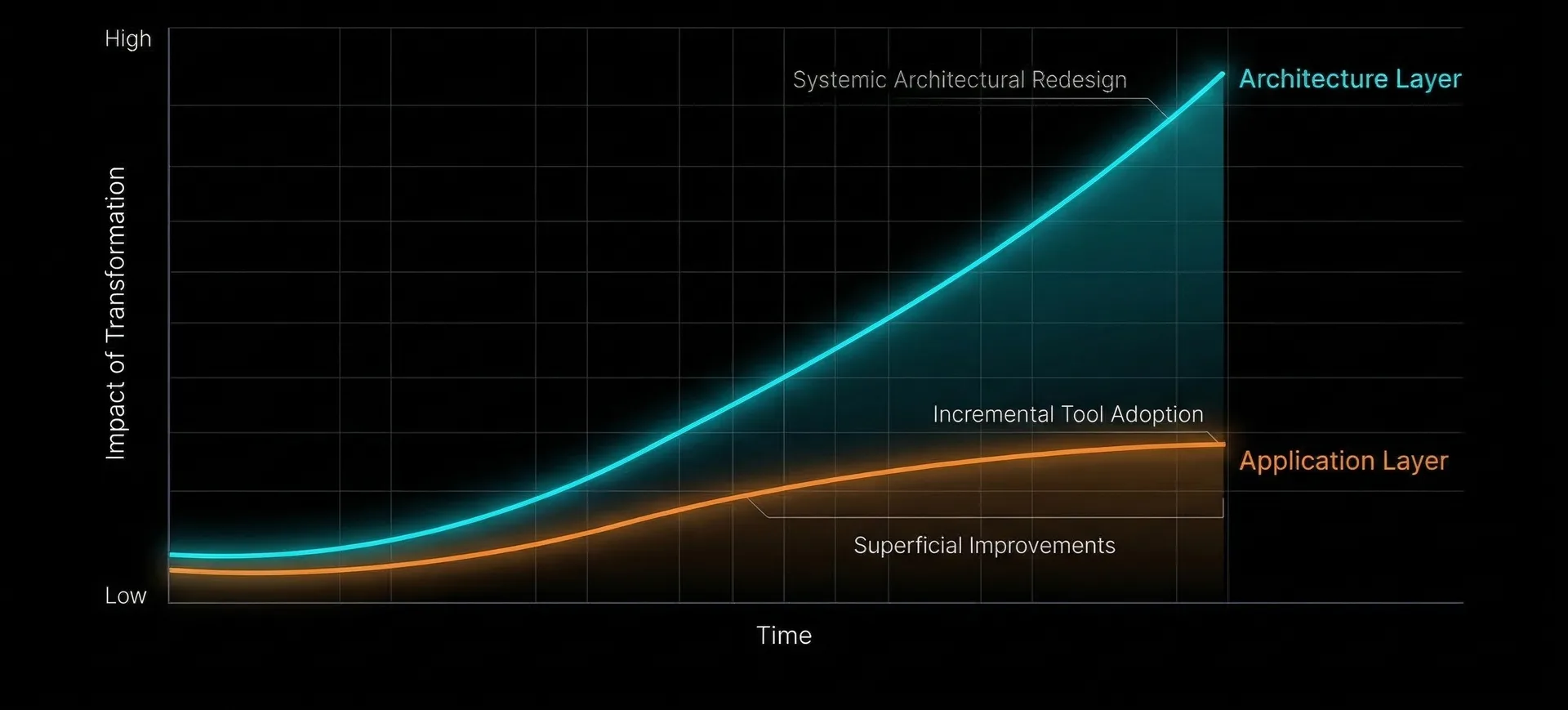
Digital Transformation is Architectural Transformation
Preparing for AI and Advanced Workloads
An emerging dimension of digital transformation is AI integration. However, AI systems demand infrastructure readiness.
Organizations must establish:
- Scalable data pipelines for training workloads
- Isolated compute clusters for experimentation
- Model registry and version control systems
- Monitoring frameworks for model drift
- Secure integration layers for inference services
Introducing AI into legacy systems without architectural preparation leads to brittle integrations and unreliable performance.
Architectural transformation ensures that advanced workloads integrate seamlessly into existing ecosystems.
Measuring Transformation Through System Characteristics
Digital transformation should not be measured by the number of tools adopted. It should be measured by architectural properties.
Indicators of successful transformation include:
- Independent deployability of services
- Horizontal scalability without service redesign
- Observable system behavior through unified telemetry
- Reduced coupling between domains
- Automated infrastructure lifecycle management
- Resilience through fault isolation
When these characteristics are present, systems can evolve continuously rather than requiring periodic large scale rewrites.
Conclusion
Digital transformation is frequently positioned as a strategic initiative. In reality, it is an architectural undertaking.
Modern organizations must redesign system boundaries, decouple services, modernize data infrastructure, automate operational workflows, and implement scalable governance frameworks. Without these structural changes, digital initiatives remain superficial.
Architectural transformation enables adaptability. It allows enterprises to integrate emerging technologies, scale workloads dynamically, and respond to market demands without destabilizing core systems.
The future of digital transformation will not be defined by applications alone. It will be defined by the robustness, modularity, and evolvability of the underlying architecture.